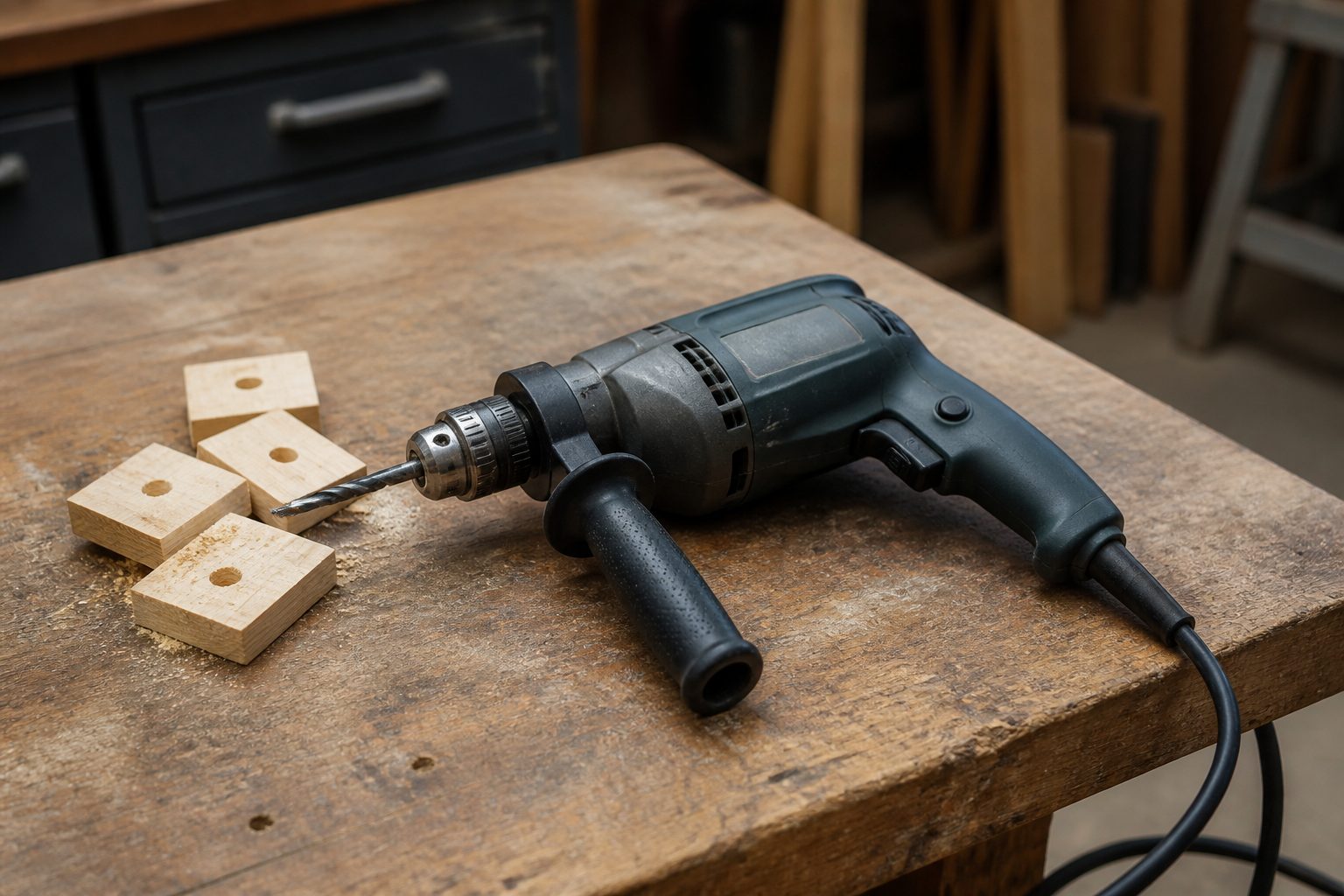

Corded Drill Buying Guide
Cordless drills get most of the attention these days, but corded drills still have a real place in a workshop, especially for repetitive or heavy-duty work. Here is what to consider if you are looking at a corded model or a drill/driver combo kit.
Why Choose Corded
The biggest advantage of a corded drill is consistent power for as long as it is plugged in, with no battery to run down or recharge mid-project. This makes corded drills a good fit for long, repetitive jobs, like drilling dozens of holes in a row, where stopping to swap or charge a battery would slow things down. Corded drills are also usually less expensive than a comparable cordless model, since there is no battery or charger to include in the price, and they tend to be lighter without a battery pack attached to the handle.
When Corded Still Makes Sense
Corded drills are worth considering for stationary or near-stationary work close to an outlet, workshop use where the drill stays in one place most of the time, and any job involving continuous, heavy-duty drilling where battery runtime would otherwise become a limiting factor. They are less convenient for jobs that move around a property or job site, where an extension cord becomes cumbersome.
Hammer-Drill Function for Masonry
Many corded drills, and some cordless ones, include a hammer-drill setting that adds a rapid hammering action to the rotation of the bit. This is what allows the drill to bore into masonry, brick, and concrete, materials a standard rotary-only drill struggles with. If any part of your project involves drilling into masonry, confirm the drill has a hammer function and that you are using masonry-rated bits, since a standard drill and bit combination will wear out quickly or fail outright on hard materials.
Drill/Driver Combo Kits
Combo kits pair a drill with a separate driver, or bundle a drill with other tools like an impact driver, often sharing a battery platform on cordless kits. For someone building out a first set of tools, a combo kit can be more cost-effective than buying each tool separately, and ensures the tools are matched in terms of battery and charger compatibility if going the cordless route. Even in a mostly cordless kit, it is worth checking whether a corded option is available for the specific drill if the work will involve long, continuous use.
Other Things to Check
- Chuck size: As with cordless drills, a larger chuck accepts bigger bits for heavier-duty work.
- Variable speed trigger: Lets you slow down for precision or delicate materials and speed up for larger holes.
- Cord length: A longer cord reduces how often you need an extension cord, which is worth checking if working away from an outlet.
Choose corded over cordless when the work is heavy, repetitive, close to a power source, or involves masonry that calls for a reliable hammer-drill function.
Product Comparison: Top Corded Drills
Corded drills are judged mainly on motor consistency and, for masonry work, hammer-drill performance. These are commonly recommended models.
| Product | Best For | Why It Stands Out |
|---|---|---|
| DeWalt DWD115K Hammer Drill | Best Overall | DeWalt’s corded hammer drill line is a common pick for masonry and heavy-duty repetitive drilling thanks to consistent, reliable power. |
| Bosch 1191VSRK Hammer Drill | Best for Masonry | Bosch’s corded hammer drills are frequently recommended for concrete and brick work, with a reputation for smooth hammer-mode transitions. |
| Makita HP1631K Hammer Drill | Premium Pick | Makita’s corded hammer drill combines a durable motor with a comfortable grip, popular with users who drill masonry regularly. |
| Black+Decker BDEDMT Drill/Driver | Best Value | A budget-friendly corded option well suited to light household drilling and driving tasks. |
As an Amazon Associate, StingyOwl earns from qualifying purchases at no extra cost to you.