Dishwasher Sizes and Types Explained: Built-In vs. Freestanding vs. Countertop
The dishwasher decision comes down to one question first: is there already a 24-inch (or 18-inch) cabinet opening plumbed and wired for a dishwasher, or are you starting from a kitchen with no built-in slot at all? That single fact determines whether you’re shopping built-in, freestanding, or countertop models — and shopping the wrong category wastes far more time than comparing brands within the right one.
Built-in dishwashers: the standard for a plumbed kitchen
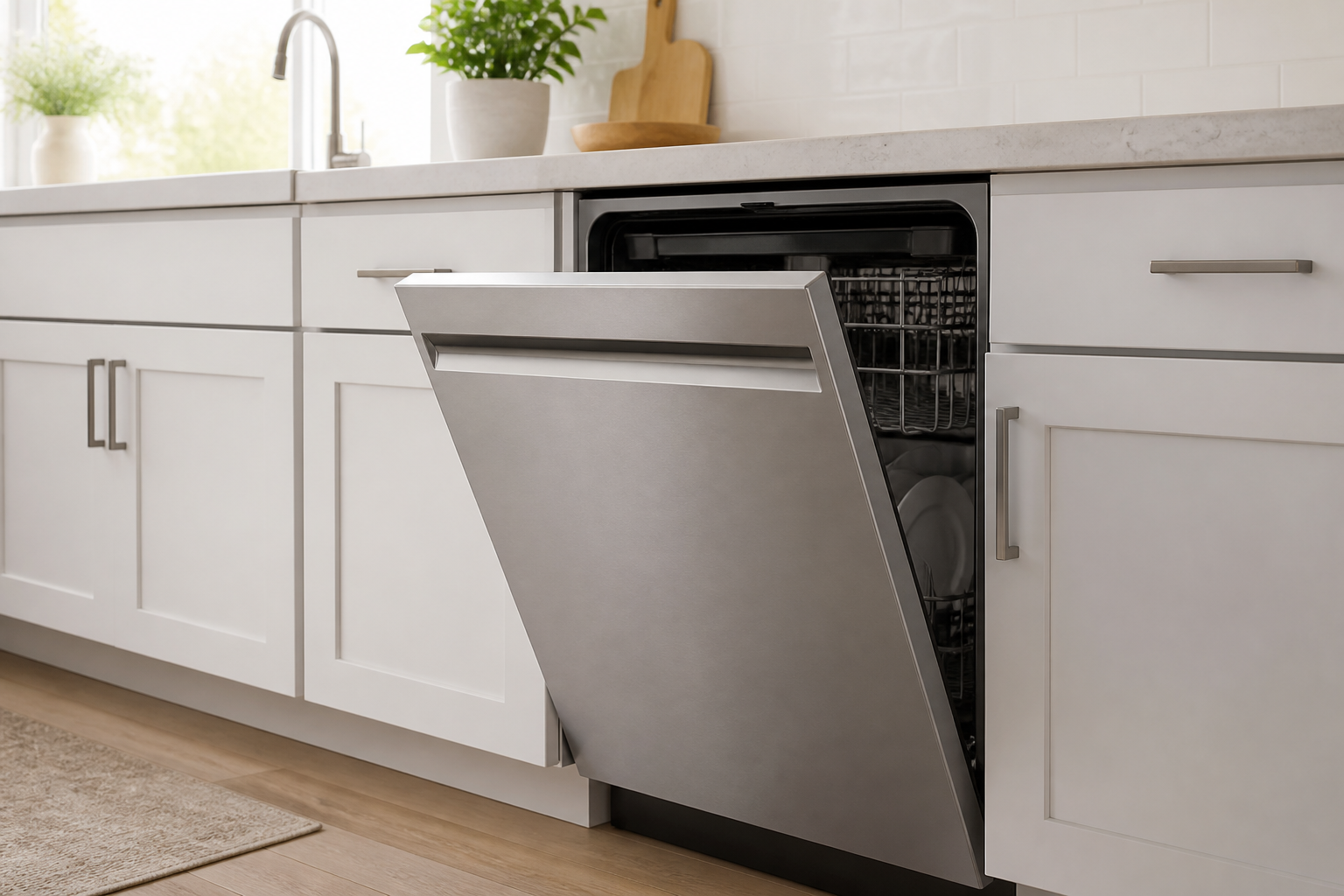
Built-in dishwashers slide into a cabinet-height opening (standard width is 24 inches, with 18-inch “slimline” models for narrow kitchens) and connect permanently to the water supply, drain line, and electrical circuit. They’re the quietest, highest-capacity, and generally best-performing category, because their consistent form factor lets manufacturers focus engineering on wash performance rather than portability. If your kitchen already has a dishwasher (even a dying one) in a cabinet slot, a built-in replacement is almost always the right call — the plumbing and electrical work is already done.
The tradeoff is installation: a first-time built-in install (no existing dishwasher slot) usually requires a plumber or a confident DIYer to run a water line, drain, and dedicated electrical circuit, which adds real cost and time beyond the appliance price itself.
Freestanding dishwashers: no permanent installation required
Freestanding (sometimes called “portable”) dishwashers are self-contained units on wheels that connect temporarily to a kitchen faucet via a quick-connect adapter and drain into the sink, with no permanent plumbing modification. They’re the practical choice for renters, older homes without dishwasher plumbing, or anyone who wants the option to take the appliance with them when they move. Wash performance on quality freestanding models has closed much of the historical gap with built-ins, though capacity is usually somewhat smaller and the unit needs to be rolled to the sink and connected before each use (or left permanently connected if space allows).
Countertop dishwashers: the space-constrained option
Countertop dishwashers are compact units, roughly the size of a large microwave, that sit on a counter and connect to the faucet the same way freestanding models do. They fit 4 to 6 place settings rather than the 12+ of a full-size unit, making them suitable for studio apartments, RVs, or single-person households — but genuinely limiting for a family that runs a full load daily. Because they lack the water pressure and spray-arm geometry of full-size units, wash performance on heavily soiled cookware is usually noticeably weaker.
Matching size to household, not just kitchen space
- Existing cabinet slot present: built-in, 24-inch standard width unless the opening measures narrower.
- No plumbing, renting, or planning to move: freestanding is the practical middle ground — full capacity, no permanent installation.
- Single person or occasional use, very limited counter/floor space: countertop, accepting the smaller capacity as the tradeoff.
- Households of 4+ running a load daily: avoid countertop regardless of space constraints — the capacity mismatch means running the cycle far more often than a full-size unit would require.
A common mistake: buying by price before confirming the opening
The single most common dishwasher buying mistake is ordering a built-in model before measuring the actual cabinet opening — width, depth, and height all matter, and older kitchens sometimes have nonstandard openings that don’t accommodate a modern 24-inch unit without cabinetry work. Measuring first, then shopping within the confirmed width, avoids a costly return or an unplanned carpentry job.
Energy and water use vary more between models than between types
It’s a common assumption that built-in dishwashers use more energy or water than freestanding or countertop units simply because they’re larger, but in practice, efficiency depends far more on the specific model’s design (soil sensors, wash cycle engineering, water heating approach) than on its category. A well-engineered full-size built-in running a normal cycle for a full load is often more water-efficient per place setting than a compact countertop unit run twice to wash the same number of dishes. Checking a specific model’s rated water-per-cycle and energy-efficiency certification is more informative than assuming smaller automatically means more efficient.
Once you know your category, performance is what separates models
Once you’ve confirmed which category fits your kitchen, the real differences between individual models come down to noise level, wash-cycle flexibility, and rack design — exactly what separates the leading built-in options from each other. The Bosch 800 Series vs. Miele G7366 vs. KitchenAid KDTM404 comparison breaks down exactly those differences for anyone shopping in the built-in category.