
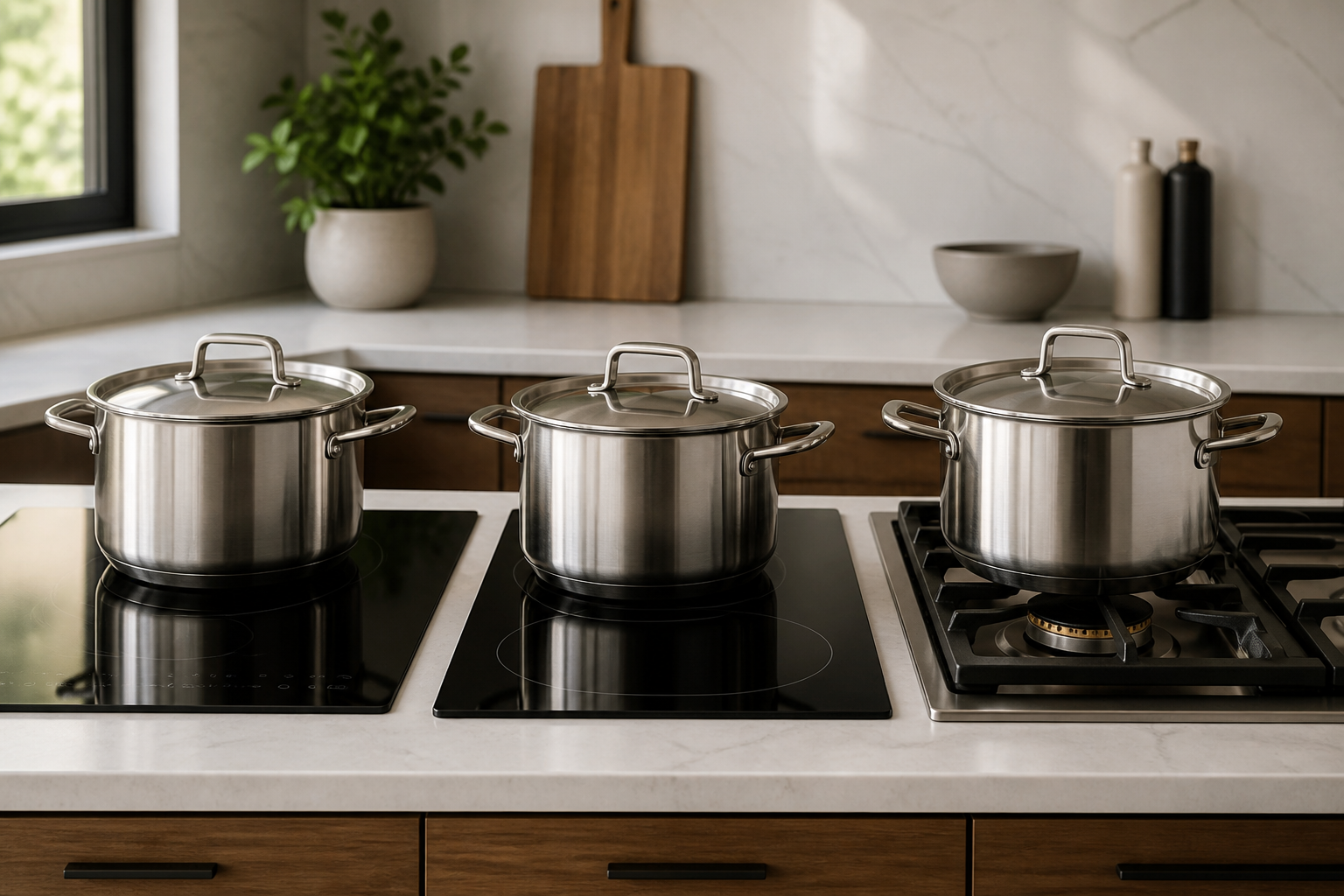
Induction vs. Ceramic vs. Gas Cooktops: Which Cookware Actually Works on Each
The one rule that governs cookware compatibility across all three cooktop types: induction requires a magnetic cooking surface, gas and ceramic glass do not care about magnetism but do care about a flat, stable base. Get those two facts straight and the rest of the buying decision follows logically.
Induction: the magnet test decides everything
Induction cooktops generate heat through a magnetic field that only works with ferromagnetic cookware — meaning the pan itself must contain enough iron to respond to a magnet. The simplest test: if a refrigerator magnet sticks firmly to the underside of a pan, it works on induction; if it doesn’t stick, the pan is dead weight on an induction burner and will generate no heat at all.
Cast iron and enameled cast iron work reliably on induction. Plain stainless steel does not always work — it depends on the specific alloy — which is why quality stainless cookware for induction use is typically constructed with a magnetic stainless or steel base layer bonded beneath the cooking surface. Pure aluminum, copper, and glass cookware never work on induction unless a manufacturer has bonded a magnetic base layer onto them.
Ceramic glass (electric radiant) cooktops: flat bottoms matter most
Ceramic glass cooktops (the smooth, electric radiant-heat surfaces common in many kitchens) have no magnetic requirement, but they demand a flat, stable pan base more than any other cooktop type. A warped or slightly domed pan bottom — common in older or thin cookware — makes poor contact with a flat glass surface, leading to uneven heating and, in some cases, hot spots that can stress the glass itself over time. Cookware with rounded or ridged bottoms (some traditional woks, for example) generally performs poorly on ceramic glass regardless of material.
Weight also matters differently here than on gas: dragging heavy cast iron across a ceramic glass surface risks scratching it, so lifting rather than sliding cookware is the safer habit specific to this cooktop type.
Gas: the most forgiving of the three
Gas burners heat cookware directly with an open flame, so they have no magnetic requirement and are far more tolerant of an imperfectly flat pan bottom than ceramic glass is — the flame simply wraps around whatever shape is presented to it. This is why gas remains the preferred cooktop for traditional woks and other round-bottomed cookware. Gas is the one cooktop type where virtually any cookware material — cast iron, stainless, aluminum, copper, even some ceramic cookware — performs predictably, as long as the pan is appropriately sized for the burner.
Cookware that works everywhere
- Cast iron and enameled cast iron: works on induction, ceramic glass, and gas without exception, though its weight makes it the one to lift rather than slide on glass cooktops.
- Multi-clad stainless steel with a magnetic base layer: works across all three cooktop types and is the most common “buy once, works anywhere” choice for anyone who might switch cooktop types in the future (a move, a renovation, an induction upgrade).
- Thin, single-layer aluminum or copper without a bonded magnetic base: works on gas and ceramic glass, but never on induction.
Cooktop type also affects day-to-day cookware care
Beyond compatibility, the cooktop in use affects how cookware should be handled day to day. On ceramic glass, cookware should always be lifted rather than dragged, since sliding even lightweight pans can leave fine scratches over time. On gas, pot supports (grates) can leave discoloration marks on polished stainless bottoms if left wet after washing, so drying cookware promptly helps it stay looking new longer. Induction cooktops are generally the gentlest on cookware finishes, since there’s no direct flame and no glass-on-metal contact to manage — the main consideration there remains purely the magnetic-base requirement covered above.
Buying once for whatever cooktop comes next
Anyone unsure whether a future move or kitchen renovation might change their cooktop type is generally better off choosing multi-clad stainless cookware with a magnetic base layer, since it’s the one construction that performs well and remains compatible across induction, ceramic glass, and gas. The All-Clad D3 vs. Made In vs. Tramontina Tri-Ply cookware comparison breaks down exactly this category of universally compatible cookware.